
The full story
A private venture network needed more than an upload page. It needed one system to read a pitch deck, money model and written plan together. The system then had to show what was ready, what did not match and what a person should check.
The idea and the risk
The first idea sounded simple. A founder uploads a pitch deck. AI reads it. Good deals reach investors.
The real job carries more risk. The system helps people decide where money may go. A founder may question a poor score. An investor needs clear facts. So the AI could not give a quick score with no proof.
A deal is not ready or unready from one answer. A good review must compare the story, the sums, the guesses and the risks.
A strong pitch can clash with its money model. A sheet can show growth but hide fixed numbers, broken sums or a weak plan. An AI recap can miss those gaps. This system had to find and show the proof, while people kept control of the review.
The review job
The venture network already chose which founders to put in front of investors. Its team used care, judgement and strong investor links. More founder files meant more work by hand. One entry could hold:
- A pitch deck, money model and written plan
- Sales claims and guesses about growth
- A fund target and a plan for how long the cash will last
- The place the firm wants in its market
- Facts that are missing or do not match
A full check takes time. Two people may also read the same file in different ways. The team needed help with these questions:
- Is the deck consistent with the model?
- Do the numbers support the story?
- Are any future money plans missing?
- Do formulas make the results, or did someone type them in?
- Is the deal ready for an investor check, and what facts show that?
- What should the founder fix before they send it again?
The goal was not to automate every call. It was to give the team a clearer signal as more files came in.
The AI helps people make a call. It does not make the call. The system finds facts and flags gaps. A person still uses judgement.
A two-part plan
We kept review and investor sharing apart. Phase 1 built the review core. Phase 2 could use that tested core to match and share deals with investors. This order let the team test the hard review work before any AI-led deal flow reached an investor.
Phase 1: the review core
Phase 1 was an in-house check tool. It had to show why it raised each point, keep a record and let a person change the result.
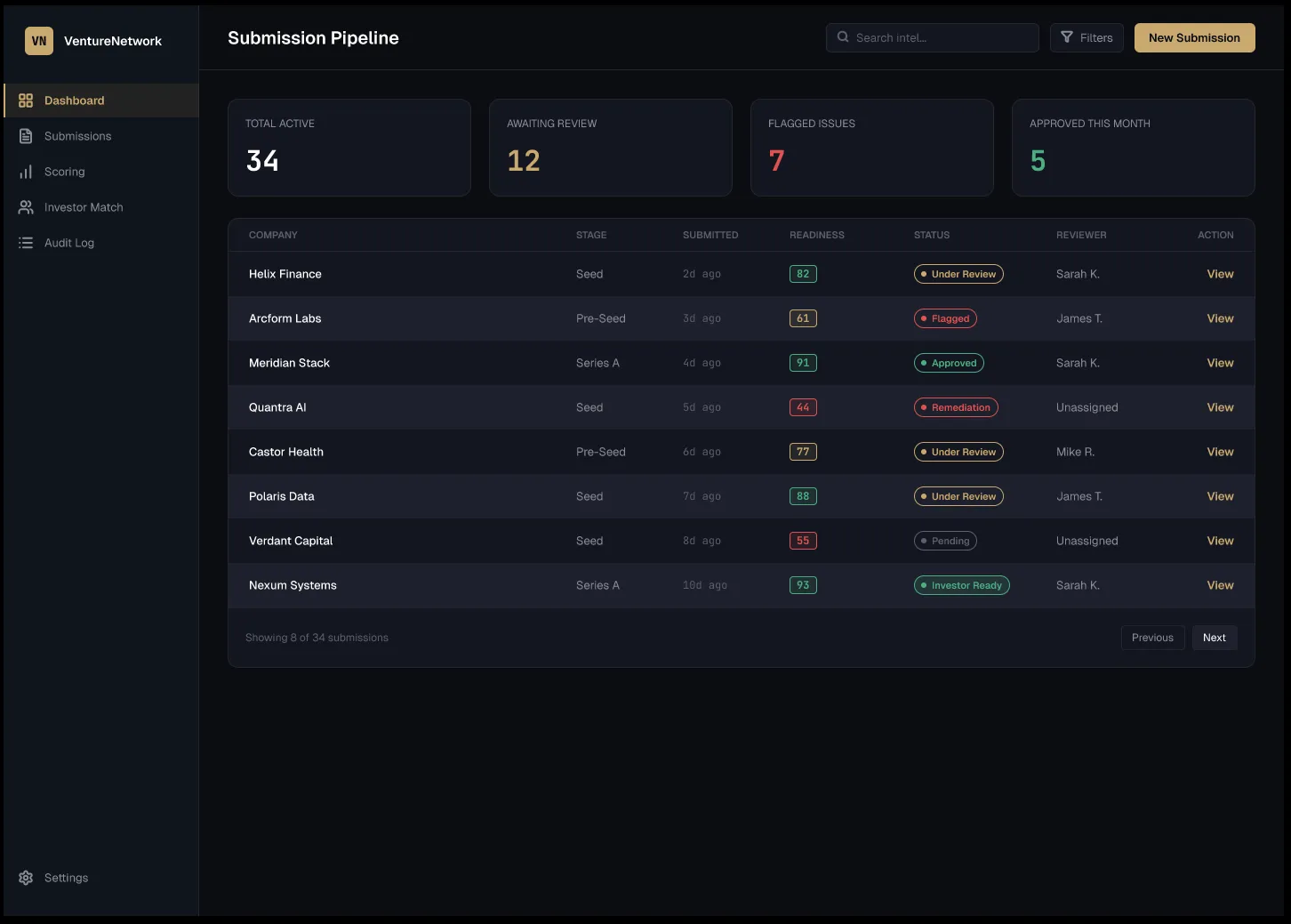
Founders could upload files. The in-house team still chose what reached investors. The system showed facts, marked clashes and gave a ready score for a person to review. It did not say, “Fund this firm.” It said what the files showed, what did not match and what needed a closer look.
How the review moves
The system checks a deal in steps. It starts with the founder's files. It checks the files, tests the money model, compares claims, gives a score and asks a person to review it. The team then sends it back for fixes or clears it to share with investors.
The parts of the system
File intake and checks
First, the system checks that each file is safe and fit to read. It takes pitch decks, written plans and money models. It checks the file, its form, access rights, safety and past versions. A broken or wrongly named file must not change the score.
Money model checks
The money model check sits at the heart of the build. It does not guess if the firm will win. It asks a smaller question: does this sheet work like a sound money model?
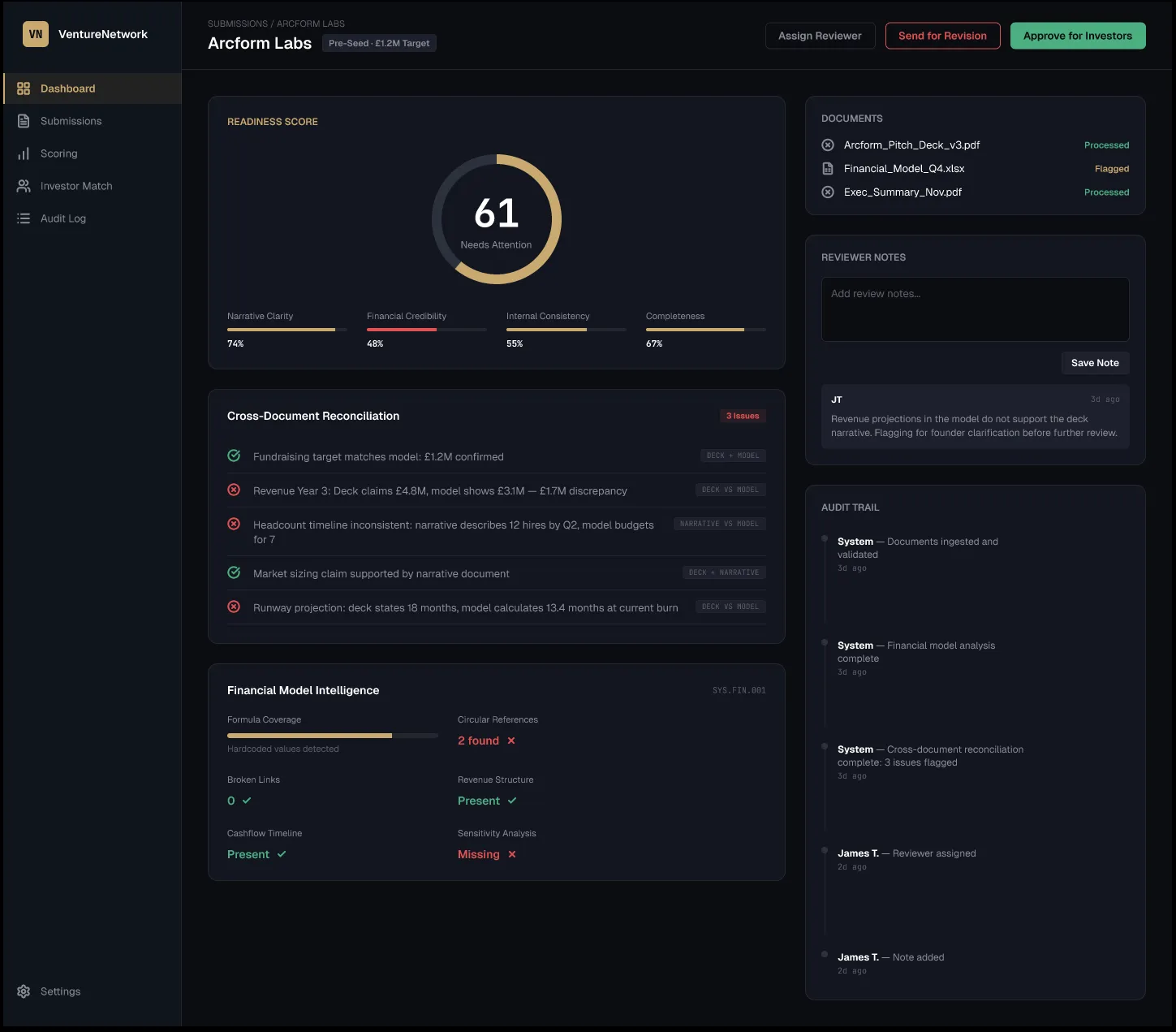
It looks for future plans, working formulas, broken links and sums that point back to themselves. It also checks if sales, costs and cash line up over time. These checks show if the model is sound enough for the next review.
Compare every file
A founder may say one thing in the deck and show another in the sheet. The system pulls out key claims and checks them against the money model.
A deck may claim £5m in sales in year three while the model shows £3.1m. This does not prove that the founder is wrong or unfit to fund. It does need a check. The system marks the clash and shows the source. It does not make up a reason, pass the deal or fail it.
The ready score
The ready score is a guide, not a final call. It looks at the clear story, the form of the money model, facts that match and facts that are present. Missing, weak or clashing proof lowers the score. Each lost point has a reason, a source and a fix. The founder can use that detail before they send the files again.
People stay in control
The system can check, flag, score and suggest. It cannot pass an investment, reject a founder or send a deal on its own. This helps the team manage AI risks such as:
- Made-up reasons
- Scores that sound too sure
- Files made to fool the score
- Rare cases and AI that changes over time
- Calls with no clear reason
Fixed checks run before the AI review. The score uses careful limits. The system compares all files and sends rare cases to a person. It shows risk so the team can review it.
Phase 2: safe investor sharing
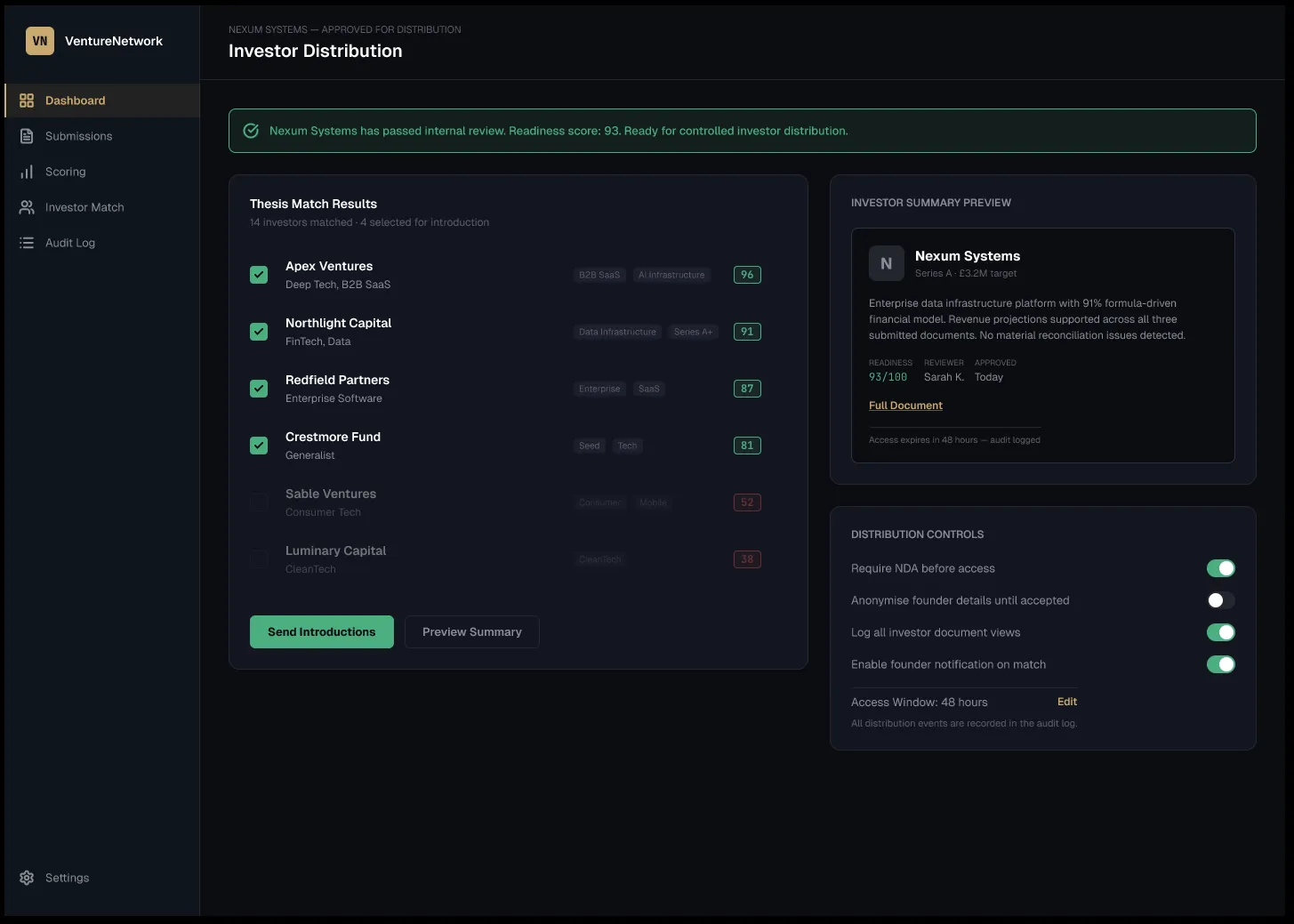
Once the team has tested the review core, phase 2 can help share deals. It can record what each investor looks for, match deals, make safe short notes, control an intro and log access. No deal reaches an investor just because the AI says so. The team still chooses the route.
What this can add
The platform aims to give investors a clearer signal before they spend time on a deal. It can give the network:
- A quality check before a deal reaches investors
- A clearer signal for well-prepared founders
- One check path for direct deals, events and members
- A system that holds the team's own review rules
- A way to review more entries without adding the same amount of work by hand
The value is not just speed. It is a clear review path that keeps people in charge.
More than a pitch recap
This is not only an AI recap. It takes in pitch decks, tests money models and reads written plans. It compares claims, gives a score with proof, makes short notes, keeps people in control, helps match investors and logs the work. It reads the files as one set of proof.
A fast AI recap is not enough for this job. The system also needs fixed money checks, file-to-file checks, clear scores, full logs and a person in charge.
The working result
The design gives the network one controlled way to take in founder files, spot clashes, test a money model and get a deal ready for a human review. Nothing needs to reach an investor before the team clears it. The system supports more intake while the team's care and judgement stay part of every route.
The key point
This platform was planned for a better review, not just a faster one.
A neat deck can hide weak guesses. A smart sheet can fail simple checks. A good story can clash with the sums. This system brings those gaps into view before a deal reaches an investor. It gives people better proof for the call they still own.